domingo, 21 de agosto de 2022

HAVE TO

 馃崏 Tener que / have to se usa como una obligacion o una necesidad de hacer algo


Ejemplos:

- You have to finish this report

- She has to work on sunday

- My mom has to buy new clothes

- We have to take next flight

- I don't have to work on weekends

- She doesn't have to get up early

- Do I have to study english?

- Do you have to do the homework?

- Does she have to call her mom tonight?

馃尮馃尭馃尯馃尮馃尭馃尯馃尮馃尭馃尯馃尮馃尭馃尯馃尮馃尭馃尯馃尮馃尭馃尯馃尮馃尭馃尯馃尮馃尭馃尯馃尮馃尭馃尯


CAN - CAN'T

Podemos usar can de varias maneras, pero habitualmente lo usamos para describir habilidades o preguntar por las mismas, para peticiones se puede usar. algunos ejemplos.


馃尭 Positivo

Ejemplo

- I can play piano

- I can bake cookies

- You can ride a bike 

- She can sing 

- He can play soccer


馃尭Negativo

ejemplo

- I can't play guitar

- you can't go the concert

- he can't speack chinese

- she can't go that party

- they can't fix cars


馃尭Pregunta

Ejemplo

- Can I play a littel more?

- Can I eat some more?

- Can you play an instrument?

- Can you open the window?


馃尫馃尫馃尫馃尫馃尫馃尫馃尫馃尫馃尫馃尫馃尫馃尫馃尫馃尫馃尫馃尫馃尫馃尫馃尫馃尫馃尫馃尫馃尫馃尫馃尫馃尫


s谩bado, 20 de agosto de 2022

mi茅rcoles, 22 de junio de 2022

WH - questions en presente simple

 馃崏 Las wh-questions son las llamadas preguntas especificas porque no pueden responderse simplemente con un Si o un No.


馃崐 Este tipo de preguntas comienzan con un pronombre interrogativo es decir con cualquiera de las wh-words.

馃崐Estos son:

馃崑 What (que)
馃崑 When (cuando)
馃崑 Where (donde)
馃崑 Who (quien)
馃崑 Why (por que)
馃崑 Whom (a quien)
馃崑 Which (cual)
馃崑 How (como)
馃崑 How many (cuantos - para sustantivos contables)
馃崑 How much (cuanto - para sustantivos incontables)


馃崓 En el tiempo verbal presente simple podemos utilizar tres verbos auxiliares (to be, to have, to do). 

- Where is this subway
- Whose is this subway
- Where does she live?
- Where does he go for his holiday?
- When does ir start?


馃崙 Examples:

- Do I look like my brother?
- Do you like fishing in the afternoon?
- Does she speak more than 4 languages?
- Do we need to call her before the meeting?

馃崗 Para este tipo de preguntas la respuesta seria normalmente una yes or no

- Do you like writing poems? 
* Yes, I do
* No, I don't

馃崗 Pero en ocasiones la respuesta puede ser mas especifica

- Do you like writing poems?
* I hate poetry 

馃尭馃尭馃尭馃尭馃尭馃尭馃尮馃尮馃尮馃尮馃尮馃尮馃尮馃尫馃尫馃尫馃尫馃尫馃尫馃尫馃崁馃崁馃崁馃崁馃崁馃崁馃尯馃尯馃尯馃尯馃尯


martes, 21 de junio de 2022

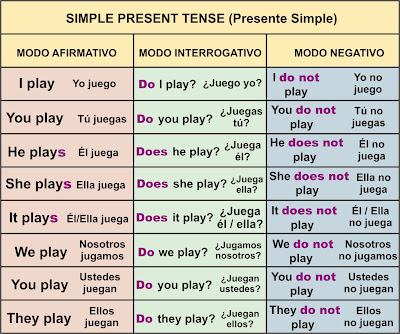
Present Simple

 馃尫 El present simple o el presente simple hace parte de los tiempos verbales del ingl茅s.

馃挏Claves para usar presente simple馃挏

馃懟Cuando se quiere comunicar estados o acciones.

馃懟Cuando se quiere manifestar estados o situaciones que son rutinas o que se realizan periodicamente.

馃懟Cuando se quieren dar indicaciones, instrucciones y se帽ales.

馃懟Cuando se quiere transmitir citas, hechos o compromisos que pasatan en un tiempo determinado.

馃挓Estructura馃挓

馃懢 Afirmativa: sujeto + verbo + complemento.

馃懢 Negativa: sujeto + auxiliar do/does not + verbo + complemento.

馃懢 Interrogativa: auxiliar do/does + sujeto + verbo + complemento.


馃悵Conjugacion馃悵
馃嵂 Presente simple:

馃嵂 Conjugacion de "Drink" en forma afirmativa:

- I drink too much coffee.
- You drink too much coffee.
- He drinks too much coffee.
- She drinks too much coffee.
- It drinks too much coffee.
- We drink too much coffee.
- They drink too much coffee.

馃嵂 Conjugacion de "Have" en forma afirmativa:

- I have a cat.
- You have a cat.
- He has a cat.
- She has a cat.
- They have a cat.
- We have a cat.

馃嵂 Conjugacion de "Drink" en forma negativa:

- I do not drink too much coffee.
- You do not drink too much coffee.
- He does not drink too much coffee.
- She does not drink too much coffee.
- It does not drink too much coffee.
- We do not drink too much coffee.
- They do not drink too much coffee.

馃嵂 Conjugacion de "Have" en forma negativa:

- I do not have a cat.
- You do not have a cat.
- He does not has a cat.
- She does not has a cat.
- They do not have a cat.
- We do not have a cat.

馃嵂 Conjugacion de "Drink" en forma interrogativa:

- Do I drink too much coffee?.
- Do you drink too much coffee?.
- Does he drink too much coffee?.
- Does she drink too much coffee?.
- Does it drink too much coffee?.
- Do we drink too much coffee?.
- Do they drink too much coffee?.

馃嵂 Conjugacion de "Have" en forma afirmativa:

- Do I have a cat?.
- Do you have a cat?.
- Does he has a cat?.
- Does she has a cat?.
- Do they have a cat?.
- Do we have a cat?.

馃崼Presente simple y la tercera persona馃崼

馃尲En las oraciones afirmativas del presente simple a todos los verbos se les agrega adiciona una S al final y al encontrarse en oraciones negativas e interrogativas la S no debe ponerse.

En el caso de los verbos que finalizan en O, SH, CH, SS, X y Z se debe a帽adir ES.

Ejemplo de esto:

verbo                                Tercera persona
- To go --------------------- He goes
- To wish ------------------ She wishes
- To catch ----------------- He catches
- To kiss ------------------- She kisses
- To mix ------------------- He mixes
- To whiz ------------------ She whizzes


馃尲 Para los verbos finalizados en Y se debe reemplazar por la I y luego adicionar ES.

verbo                                Tercera persona
- To cry -------------------- He cries
- To spy -------------------- She spies
- To worry ----------------- He worries


馃尲 Hay una excepcion para los verbos terminados en Y cuando hay una vocal antes de la Y se conserva esta letra pero se adiciona una S.

verbo                                Tercera persona
- To pay ------------------- He pays
- To say ------------------- She says
- To lay ------------------- He lays


馃尲 En tercera persona usamos el auxiliar Does pero en primera y segundam persona del singular y plural usamos el auxiliar Do

Oraciones afirmativas:
verbo                                
- He                                 
- She                   DOES
- It                                 

Oraciones negativas:
- He                                          
- She                   DOES NOT
- It                                          

Oraciones interrogativas:
                         He 
  DOES            She
                         It

馃懢馃懢馃懢馃懢馃懢馃懢馃懢馃挓馃挓馃挓馃挓馃挓馃挏馃挏馃挏馃挏馃挏馃挏馃挏馃崌馃崌馃崌馃崌馃崌馃崌馃崌馃崌馃崌


ta bien bonita la cerezita

s谩bado, 18 de junio de 2022

My Family


馃尭馃尭馃尮馃尮馃尮馃崌馃崌馃崌馃崜馃崜馃崜馃崜馃崚馃崚馃崚馃崚馃崷馃崷馃崷馃崹馃崹馃崹馃嵃馃嵃馃嵃馃惐馃惐馃惐


viernes, 17 de junio de 2022

Directions and location with prepositions

 馃惞 Los "Prepositions of location" son palabras que se utilizan para describir el lugar donde se encuentra un determinado bjeto en un momento determinado. 


Es importante tener un lenguaje basico, las palabras mas importantes son:


Vocabulary


馃尭馃尭馃尭馃尭馃尭馃尭馃尫馃尫馃尫馃尫馃尫馃尫馃尮馃尮馃尮馃尮馃尮馃尮馃尮馃崄馃崄馃崄馃崄馃崄馃崄馃崜馃崜馃崜馃崜馃崜馃崜馃崚